14 Detox, and the treatments that follow, can take place in inpatient or outpatient settings:14 Inpatient treatment is any treatment needing the individual to live at the center while receiving services. Inpatient programs are typically housed in medical facilities or standalone treatment centers and differ in duration, with longer inpatient treatment frequently described as property treatment.
Outpatient treatments permit the private to attend services during the day and sleep in their own bed during the night. Outpatient is typically a much better fit for individuals with less extreme dependencies and/or strong social media networks. Outpatient treatments may continue for many years and levels of care consist of: Partial hospitalization programs (PHPs).
Extensive outpatient programs (IOPs). Somewhat less intensive than PHPs, IOPs supply between 6 and 9 hours of treatment every week. Standard outpatient. This is the least time intensive outlet for outpatient care, offering hour-long sessions weekly or month-to-month. Someone who completed inpatient detox may transition to some type of continuous treatment to keep their momentum, such as residential treatment, PHP, IOP, or basic outpatient.
Another choice for individuals presently in or completed with treatment is support groups. Support system are meetings arranged and run by individuals in recovery that focus http://cesarqcdt899.theburnward.com/what-is-drug-abuse-addiction-for-beginners on fellowship, continued focus on sobriety, and returning to others as a method to remain drug-free. For many, dependency treatment is a long-lasting process with continuous professional treatment and aftercare alternatives to keep healing.
All About How To Get Help For Drug Addiction Without Money
3 Whether you believe addiction is an illness or not, everybody can concur that dependency is a severe problem that negatively impacts the lives of the people utilizing substances along with individuals in their lives. The suffering that occurs with addiction can be immense, but treatment provides a ray of expect the future.
( 2018 ). Grant, J. E., Potenza, M. N., Weinstein, A., & Gorelick, D. A. (2010 ). Intro to Behavioral Dependencies. The American Journal of Drug and Alcohol Abuse, 36( 5 ), 233241. http://doi. org/10. 3109/00952990. 2010.491884. fo National Institute on Substance Abuse. (2018 ). Holden, T. (2012 ). Addiction is not an illness.
Heyman, G. M. (2013 ) - which of the following is not a possible sign of a drug addiction?. Addiction and Choice: Theory and New Data. Frontiers in Psychiatry, 4, 31. National Institutes of Health. (n. d.). American Psychiatric Association. (2013 ). Diagnostic and analytical manual of mental disorders (5th ed.). Arlington, VA: American Psychiatric Publishing. National Institute on Drug Abuse. (2018 ).
( 2016 ). National Institute on Drug Abuse. (2018 ). Drug Abuse and Mental Health Solutions Administration. (2016 ). National Institute on Substance Abuse. (2018 ). Natioasnal Institute on Alcoholic Abuse and Alcoholism. (n. d.). Drug Abuse and Mental Health Solutions Administration. (2015 ). Detoxification and Drug Abuse Treatment.
What Is Drug Abuse And Addiction Fundamentals Explained
Dependency, medically described as a substance usage condition, is a complicated illness of the brain and body that involves compulsive use of Click for more info one or more compounds regardless of major health and social repercussions. Dependency interrupts areas of the brain that are accountable for benefit, inspiration, discovering, judgment and memory. Addiction is specified as an illness by a lot of medical associations, including the American Medical Association and the American Society of Dependency Medication.
Hereditary threat elements represent about half of the probability that an individual will establish dependency. how to beat drug addiction. Dependency includes modifications in the functioning of the brain and body due to relentless usage of nicotine, alcohol and/or other substances. The consequences of untreated dependency often consist of other physical and mental health disorders that require medical attention.
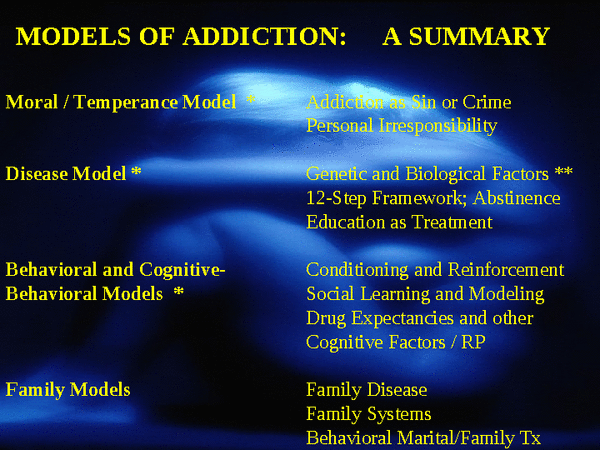

People feel pleasure when fundamental needs such as hunger, thirst and sex are pleased. In many cases, these feelings of pleasure are triggered by the release of specific chemicals in the brain, which reinforce these life-sustaining functions by incentivizing the specific to repeat the habits that produce those satisfying feelings (eating, drinking and procreating).
In time, continued release of these chemicals causes changes in the brain systems associated with benefit, inspiration and memory. The brain attempts to get back to a balanced state by minimizing its reaction to those satisfying chemicals or releasing stress hormonal agents. As an outcome, an individual might require to use increasing amounts of the compound just to feel closer to regular.
The 2-Minute Rule for Drug Addiction What Is It
The person might also prefer the compound to other healthy satisfaction and might lose interest in typical life activities. In the most persistent kind of the disease, a serious substance usage disorder can trigger a person to stop caring about their own or others' well-being or survival. These modifications in the brain can stay for a very long time, even after the person stops utilizing substances.
The initial and early decisions to utilize compounds are based in large part on an individual's free or conscious choice, typically influenced by their culture and environment. Certain factors, such as a household history of dependency, trauma or improperly treated psychological health conditions such as anxiety and anxiety, may make some individuals more prone to substance use conditions than others.
Perhaps the most specifying symptom of dependency is a loss of control over substance usage. Individuals do pass by how their brain and body react to substances, which is why individuals with addiction can not manage their use while others can. People with dependency can still stop using compounds it's simply much harder than it is for somebody who has not become addicted.
With the assistance and assistance of family, good friends and peers to remain in treatment, they increase their chances of recovery and survival. A persistent illness is a lasting condition that can be controlled but not treated. Many individuals who take part in substance usage do not establish dependency. And many people who do so to a bothersome extent, such as youths throughout their high school or college years, tend to lower their usage once they take on more adult obligations.
Some Known Questions About How To Prevent Relapse In Drug Addiction.
For them, Click here for more dependency is a progressive, relapsing disease that needs extensive treatments and continuing aftercare, tracking and household or peer assistance to handle their healing. The bright side is that even the most severe, persistent kind of the condition can be manageable, normally with long-lasting treatment and continued monitoring and assistance for healing.
While the first use (or early phase usage) might be by option, when the brain has been changed by addiction, a lot of specialists believe that the person loses control of their habits. Choice does not identify whether something is an illness. Heart problem, diabetes and some kinds of cancer involve individual choices like diet plan, exercise, sun exposure, and so on.
Others argue that addiction is not a disease since some people with dependency get much better without treatment. Individuals with a mild compound usage condition might recover with little or no treatment. People with the most severe form of addiction normally need intensive treatment followed by lifelong management of the disease.
Others attain healing by attending self-help (12-step or AA) conferences without getting much, if any, professional treatment. In all cases, expert treatment and a series of healing supports should be offered and available to any person who develops a substance use disorder. Dependency is a treatable illness.